
Status Report
What Does It Do?
The Metadata tool eliminates the need for those manually maintained and often inaccurate tracking forms by grabbing the metadata directly from the study components and outputs.
What Do You Need?
-
Any study component
Guide
-
Open Microsoft Excel.
-
Navigate to the Metadata ribbon.
-
Locate the Packages section of the ribbon.

-
Click the Status Report button in the Packages section.
-
A prompt will appear.

-
Ensure the Package Type is set to either Delivery or Archive.
-
IMPORTANT: A Delivery Report or an Archive Report do differ.
-
A Delivery Report does not show the tracking information and just shows details about the package.
-
A Archive Report shows details about the package but also the tracking information for the study.
-
-
For example purposes, Archive was selected for Package Type.
-
Then select the Package Scope, for example purposes, TFL will be selected.
-
Then select the CDISC value, for example purposes, Yes will be selected.
-
Also ensure the following fields are populated:
-
Delivery Name / Archive Name is populated with the relevant delivery name, e.g., First Draft.
-
Client Name is populated with the relevant client name, e.g., Programme.
-
Protocol Number is populated with the relevant protocol number, e.g., CT0-0012.
-
Internal Study Number is populated with the relevant project number, e.g., C24-ZZ.
-
-
IMPORTANT: Unselecting the Default Directories option, allows the user to manually select the directories for the study components, as opposed to using the standard locations, making the tool full customizable. If this is unchecked, a prompt will appear which is not illustrated below.
-
IMPORTANT: Unselecting the Default Components option, allows the user to manually select the items required for the archive / delivery, as opposed to using the default items, making the tool full customizable. If this is unchecked, a prompt will appear which is not illustrated below.
-
Click OK to continue.
-
A prompt will appear indicating the process is copying the files to the deliverable package.
-
After some time, the Report Window will display. This window is split into multiple sections Including:
-
Package
-
Repository
-
Project
-
Tracking
-
-
Package - this section details the contents of the package itself, displaying every component included and the basic metadata around the component, like its location, size, extension, status, etc. It also details if any files were not found.

-
Repository - this section details all the programs found in the study's GitHub repository and displays the program's metadata like program name, program path, last author to commit and last date the program was commit.
-
IMPORTNANT: In short this section represents a live status report of all the programs in development at any one time. It has zero risk of human error and unlike like a manually created tracking form this version is a 100% accurate representation of the study's programs at the time the package was created.

-
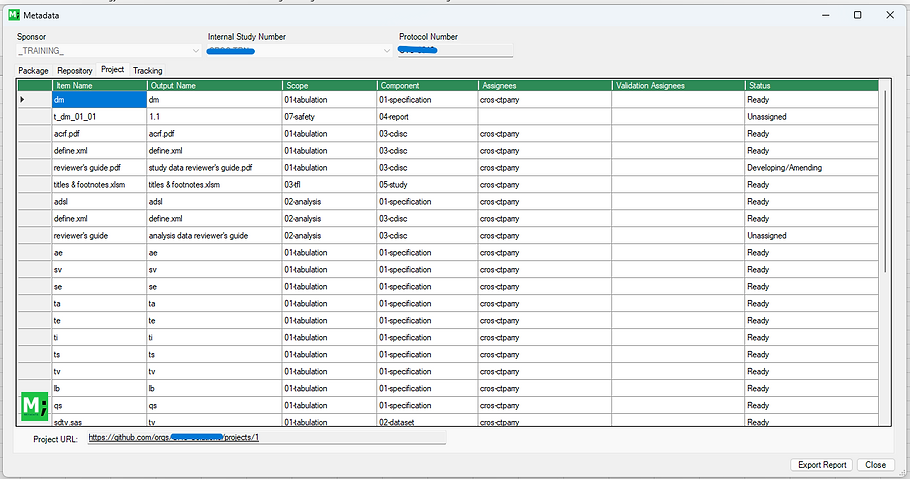
Projects - this section details all the planned outputs destined to be created and their current production status, as well as author and reviewer which comes directly from the study's GitHub Projects area.
-
IMPORTNANT: In short this section represents a live status report of all the outputs destined for development in development at any one time. It has zero risk of human error and unlike like a manually created tracking form this version is a 100% accurate representation of the study's outputs at the time the package was created.
-
Tracking - this section details all the outputs included in the package and displays the output's metadata like program, program author, program last modified date, output date etc. as well as the output's components such as the log, the dataset, the transport file, etc.
-
IMPORTNANT: In short this section represents a typical tracking form on a study with one key advantage, it has zero risk of human error. Unlike like a manually created tracking form this version is a 100% accurate representation of the study at the time the package was created.

-
Finally the user can export this report to an Microsoft Excel file, which is store within the package.
-
Simply click the Export Report button.
-
A prompt will appear asking the user to confirm the output location.

-
Click OK to confirm the directory.
-
The progress bar will reappear indicating the process is run.
-
After some time the report will be exported and a prompt will appear asking the user if they want to open the newly exported report.

-
Click Yes to open the report or No to return the previous window.
-
IMPORTANT: The excel report contains the same information as seen in the Report Window, the information is spread over different worksheets with the Excel version.
